

How to emphasize your jawline
Wearing a beard is about more than just putting the razor on the shelf; It’s about understanding the anatomy of the face and using beard trimming as a tool to enhance your best features. By mastering the art of beard trimming to place the beard lines correctly, you can visually correct the shape of the face, conjure up blurred contours and highlight a powerful jawline. In this guide, we’ll walk you through how to elevate your style from wild to well-tailored with the help of the right technique and precision in your beard trimming.
Summary: The Journey to the Perfect Beard Line
To help you navigate the jungle of beard trimming and styling, we’ve broken the guide down into four key parts that cover everything from basic geometry to the final details:
- Neckline geometry: We’ll teach you the vital “two-finger rule” and how to avoid the classic mistake of trimming too high, which is key to creating a defined and natural jaw profile.
- The character of the cheek line: Explore the difference between a natural, smooth transition and a razor-sharp, contoured line – and learn which style best complements your personal look.
- Facial Shape Balance: A walkthrough of how to adjust the length and volume of your beard to your face shape (round, square, long, narrow, or oval) to create a harmonious and proportional silhouette.
- The Master’s Toolbox: A look at the essential products, from transparent shaving gels to precision tools, that are required to achieve a professional result at home in the bathroom of your beard trimming.
1. The Golden Rule of the Neckline
By far the most common mistake when trimming a beard is to follow the edge of the natural jawbone when shaving the neck. The result is often a line that sits too high up, which gives an unbalanced impression where the beard looks too small for the face. It can also create an undesirable visual effect of a double chin, even on the most fit jaw. A correctly placed neckline instead frames the face and gives the beard a professional finish.
How to find the right one for your next beard trimming:
- The two-finger rule – your anatomical compass: To find the perfect starting point, place your index and middle fingers horizontally just above your Adam’s apple. The top edge of the top finger marks the lowest point where the beard should end. This is your “baseline.”
- Create the natural U-shape: From that point above the Adam’s apple, draw a soft, curved line upward toward the back of your ears (right where the earlobe meets your jaw). The line should not be straight as nails, but follow the natural curvature of the neck to look as natural as possible.
- The angle that defines: Any hair that grows below this imaginary U-line should be shaved off completely. By keeping the area of the neck clean, you create a sharp shadow under the jawbone. It is precisely this contrast that defines your jawline, gives your face a real lift and makes your beard trim look as if it were done by a professional barber.
- Pro tip: When performing your beard trimming, look straight into the mirror and keep your head in a natural position. If you tilt your head back too much when you cut the line, it risks ending up too high once you lower your gaze again.
Creating depth in the profile: The contrast between shadow and line
Once you’ve mastered the neckline placement, the next step in your beard trimming is all about understanding the visual interplay between light and shadow. By shaving your neck completely smooth still up to your “baseline”, you create an artificial shadow effect under your jawbone. This dark contrast against the lighter skin on the neck acts as a natural contouring; It tricks the eye into perceiving the jawline as sharper and more protruding than it really is. To maximise this effect, make sure the transition is razor-sharp – the cleaner the shave on the neck, the more powerful the impression of a well-defined profile.

2. The cheek line – Natural or sharp?
The cheek line is the main eye-catcher of the face and the factor that most immediately determines how well-groomed your style is perceived. A well-done beard trimming at the cheeks can open up the face or give it more structure, depending on the expression you are aiming for. In modern beard trimming, there are mainly two different schools:
- The natural look, subtle definition: This style is all about preserving the organic shape of the beard while cleaning up the most sprawling areas. During your beard trimming, you focus solely on picking or shaving off the occasional “lost” hairs that grow high up towards the cheekbones or under the eyes. By keeping your natural growth limit, you get a softer appearance that is perfect for a more rugged, full full beard or a relaxed lifestyle. It gives a masculine but at the same time conscious impression.
- The sharp look, architectural precision: For those who want a more defined and modern style, the sharp cheek line is the way to go. Here, you can use a shavette or a safety razor to create a razor-sharp, linear boundary. The line is usually drawn in a straight or slightly inward curve from the front edge of the sideburns down to the corners of the moustache. This type of beard trimming has an optical effect that narrows the face and highlights the cheekbones, giving a more aggressive and well-tailored profile.
- Expert’s advice: In a sharp beard trimming, symmetry is everything. Use a transparent shaving gel to see exactly where the blade meets the skin. If you’re unsure about the height, start high – it’s much easier to lower the line gradually than to wait for the hairs to grow back if you happen to shave too deep.
Geometry in profile: The angle that sculpts your facial features
When you choose between a straight or curved cheek line in your beard trimming, you are actually determining how your face shape is perceived in profile. A straight line that runs diagonally from the ear to the corner of the mouth gives a harder, more masculine and “angular” impression that is excellent for giving structure to a rounder face. If you instead choose a slightly concave (inward-curved) curve, you follow the natural shadow of the cheekbones. This creates an optical illusion of higher cheekbones and a more sculpted facelift. The key to a successful definition is to let the line land exactly where the beard is most compact; Trying to force a high line where the plant is sparse ruins the solid feeling that a well-executed beard trimming should convey.

3. Adapt to your face shape
We are all created with different conditions, and the secret to a really nice beard is to let it work with your features, not against them. By understanding your face shape, you can use your beard trimming to create optical illusions – hiding sharp angles, adding length where needed, or creating width in a slim face.
Here’s an in-depth guide on how you should think about your next beard trimming:
Round face
Strategy for the beard
Keep pages short & build length. Trim down the cheeks and sideburns thoroughly. Let the hair on your chin grow longer and shape it into a tip or a square.
Why it works?
By minimizing the volume on the sides and adding vertical length, your beard trim creates the illusion of a slimmer and more oval face.
Square Face
Strategy for the beard
Round off the corners. Focus on maintaining fullness at the chin, but use your trimmer to gently round off the sharp corners at the angle of the jaw.
Why it works?
A square jaw is already masculine; The goal of your beard trimming here is to soften the overall impression and avoid the face looking too “boxy”.
Long Slim Face
Strategy for the beard
Create horizontal width. Keep the beard shorter at the chin and instead let it be fuller on the cheeks and at the sideburns.
Why it works?
Adding volume to the sides helps to “fill out” the face. Avoid a long pointed beard as this only lengthens the face further.
Oval face
Strategy for the beard
Free playfulness. You have the most balanced shape. You can experiment with anything from a short stubble to a massive full beard.
Why it works?
Since your proportions are already harmonious, your beard trimming is more about personal style and keeping the lines clean rather than correcting the shape.
Important to remember: When trimming a beard for different face shapes, it is the balance between the beard and your hairstyle that determines the end result. If you have a lot of volume on your head, you can often wear a heavier beard, while a shorter hairstyle requires more precise and well-groomed lines so as not to look unbalanced.

4. The tools that make the difference
To achieve razor-sharp lines and a professional finish, a standard machine alone is rarely enough. The right equipment is half the victory when it comes to successful beard trimming. Here are the indispensable heroes of your bathroom cabinet and how they complement your routine:
- Beard trimmer, for rough work and length: A beard trimmer is indispensable when you need to shorten the entire beard to an even length or thin out the volume on the sides. It is fast and efficient in handling the overall shape.
- Safety razor, for the neckline and large areas: Once you’ve found your neckline, you want to get as close a shave as possible to the skin underneath. A safety razor with a single sharp blade provides an extremely close shave and reduces the risk of irritation compared to multi-blade systems. It’s the perfect choice for keeping your neck clean after your beard trimming.
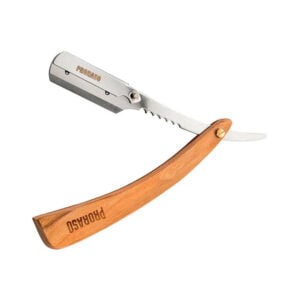
- Shavette, for razor-sharp details and cheek lines: This is the barber’s favorite tool. Because the blade of a shavette is fully exposed, you have unbeatable visibility and control. That makes it the ultimate instrument for creating those architecturally straight or curved lines on the cheeks that really define your style.
- Transparent shaving gel, your visual guide: In precision trimming, the traditional shaving foam is your enemy as it hides the line. A clear shaving gel allows you to see exactly where the blade meets the skin, reducing the risk of shaving off too much.
- Beard oil, the important aftercare: A complete beard trimming always ends with moisturizing. A quality beard oil soothes the skin, counteracts redness and gives the beard a healthy glow.
Pro-tip for the neckline: When performing your beard trimming on the neck, don’t just look straight into the mirror. Bend your head back to check the symmetry from underneath, but then lower your head to a natural position to ensure that the line doesn’t look crooked when moving around in everyday life.
Our beard trimming shaving tools
Safety razors


Shaves
-
-

-
Utgående

-


