A concept that is often talked about when it comes to safety razors is how aggressive they are. Another way to define it is how close the blade gets to the skin. In this blog post, we will try to find out what is meant by aggressiveness or harshness when it comes to safety razors.
In short, safety razors can be divided into five different stages on a scale of aggressiveness or hardness. The scale goes from Very Mild to Mild, Medium, Aggressive and Very Aggressive.
It is also important to point out that this scale should be seen for the most part as approximate guidelines and not an absolute truth. But it is a guide to help you make a good choice of safety razor for you and your needs.
What determines the aggressiveness of a safety razor?
There are four things that in the vast majority of cases determine how aggressive a safety razor is.
One of them is how high or far the distance is between the razor blade and the protective edge or spikes of a safety razor. In short, how much space is there between the razor blade and the protective comb. The function of the comb is to protect the skin from direct contact with the razor blade. It should also help raise the beard hairs to bring them closer to the razor blade.
Another factor that determines how aggressive a safety razor is depends on how much of the razor blade is exposed. A double razor blade sits between the lower and upper parts of a shaver head. The upper part protects and covers a large part of the razor blade, but not the whole of it. How much of the razor blade is exposed can make a safety razor more or less aggressive. A safety planer with a more exposed blade is more aggressive. It also has a greater ability to cut off thicker and coarser beard hairs more easily.
The angle at which the safety razor is held along with the angle of the razor blade is also a factor that determines how aggressive a safety razor is.
A closed-comb safety razor that only has one angle of the razor blade is usually slightly less aggressive than one that has an open comb.
Another part to include is how sharp or soft the razor blade is used. Sharper razor blades have a greater opportunity to cut off thicker beard hairs more easily. At the same time, the risk of cutting yourself is greater.
Different double razor blades have different sharp or soft sharpness, which can affect how aggressive the shave will be regardless of the razor. In addition, it is easier and cheaper to change first to a sharper or softer double razor blade before changing the safety razor if it does not feel right.
Very mild safety razor
A very mild safety razor is the least aggressive of all safety razors. The distance between the razor blade and the comb is very short and a very small part of the razor blade is exposed. A safety razor like this is very forgiving and almost impossible to cut yourself with. These are some of the major advantages of this type of safety razor.
At the same time, because the distance between the razor blade and the comb is short, together with very little of the razor blade being exposed, it means that coarser and thicker beard hairs can become difficult to shave off in an easy way without causing problems, for example by having to shave more times than necessary. This type is best suited for shaving off soft thin beard hairs such as feathers and the like.
Of the safety razors we sell, almost only those with a shaving head that can be adjusted in several different steps are included in this category of safety planers.
A gentle gentle safety razor together with a soft razor blade becomes very forgiving and gentle on the skin. Can be used, for example, to shave off feathers and similar hairs.
For example, several safety razors from Rockwell and Merkur have a position that can be described as very mild.
A mild safety razor is the lower of the two steps that counts as a good safety razor to start with. A mild safety razor is quite forgiving, while it can cut off thinner, softer beard hairs in a sparser beard without major problems. Here, too, the distance between the comb and the razor blade is short and a small part of the razor blade is exposed. Therefore, it is very good to shave with, especially if you have extra sensitive skin.
Something that can cause problems with this type of safety razor is that you feel that you have to shave the same place unnecessarily many times, something that can lead to skin problems if the skin is exposed to too much stress during wet shaving.
It should be said again that the difference between a very mild, a mild and a medium safety razor is also a matter of personal preference. A safety razor that is perceived as mild by some may be perceived as very mild by others. In that case, it can be too forgiving.
A good start for many can be to choose a mild safety razor together with a sharp double razor blade, sharpness 3 out of 5. Then you get a safety razor and a double razor blade that is both forgiving but at the same time can manage to shave without too much strain on the skin. Especially if you have a little more sensitive skin. A mild safety razor can also be used to shave off feathers and other hairs on the body.
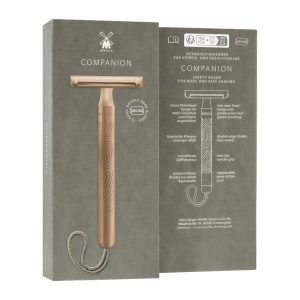
Rockwell, several of Merkur and most of Mühle’s closed-cam models can be classified as mild safety planers.
A safety razor that is at medium aggressiveness is the level we usually recommend most people to start when buying their first safety razor. This is also the level that many, almost most people stay at.
A safety razor with medium aggressiveness is both forgiving and can shave off even slightly thicker beard hairs without major problems. The vast majority of beards can be shaved with this type of safety razor. Although sometimes you may have to shave twice to be completely clean-shaven.
In short, Medium is exactly what it sounds like. Somewhere in the middle. Together with a sharp razor blade, scale 3 out of 5, this is an excellent start for those who want to try classic wet shaving with a safety razor.
Many of Merkur’s most popular models, such as their Merkur 34C, Rockwell’s popular planer 2C (which can also be slightly milder) and, for example, the D.R Harris are typical safety razors at this level. Even Rockwell can be tuned to suit this level.
A slightly more aggressive safety razor is suitable for those who do not get the shave you want with milder safety razors. Maybe your beard is quite thick. This may mean that milder safety razors need to shave the same place and beard hairs unnecessarily many times. Maybe you just want the feeling of a slightly closer shave than that which a milder safety razor can provide.
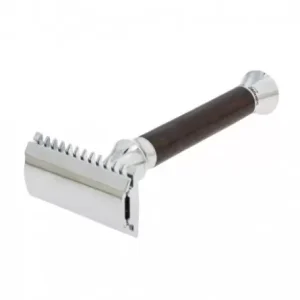
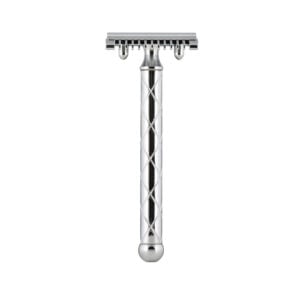
A safety planer that has an open comb instead of a closed comb is usually slightly more aggressive. At the same time, there are safety razors that have both a closed cam and are slightly more aggressive. These are mainly safety razors where the angle of the razor blade can be adjusted. When the razor blade is adjusted, for example, the distance between the comb and the blade can increase, which means that the safety razor will be much more aggressive.
The disadvantage of a more aggressive safety razor is that it can be easier to cut yourself by mistake. Especially if you use very sharp razor blades. To reduce the risk of cuts, you can either choose a slightly less sharper blade together with an aggressive safety razor. Or simply do the opposite, use a milder razor with a sharper blade.
Rockwell and Merkur have several models where the angle of the blade can be adjusted for a more aggressive shave. Even Fatip with an open comb can be counted in that category.
This is the most aggressive of the various safety razors. These almost always have an open comb. Something that suits thick beards with coarse beards. At this level, it’s almost as close to shaving as you can get with a shavette or razor. But with significantly less maintenance and the risk of damage is slightly less.
A very aggressive safety razor is not something we recommend for someone new or unfamiliar with wet shaving. This is simply because the risk of cutting yourself is too great. Something that can lead to wet shaving not feeling inviting and fun to do. Then it is better to start with a slightly less aggressive safety razor and try it out together with sharp or very sharp blades. It is also cheaper and easier.
If you know that you have an extra thick beard and want to start wet shaving, we recommend a slightly less aggressive razor together with a very sharp or very sharp razor blade. And, of course, to be careful in the beginning.
As with the other levels, it is important to point out that what may be perceived as a very aggressive safety razor for some can only be perceived as a less aggressive one for others.
ShavingWall is Shavingroom.se blog that covers classic wet shaving and beard care in three different departments.
Shaving blog where we bring up news and tips in wet shaving and beard care.
ShavingBrand where we present a brand once a month.
ShavingTest where we test different products.
At Shavingblogg, we talk about everything that has to do with wet shaving and beard care
Wet shaving means shaving with a safety razor, shavette or razor together with a shaving brush and shaving cream or shaving soap. What should you consider when buying your first safety razor, shavette or razor? What type of shaving brush should you choose? Should you choose shaving cream or shaving soap?
Beard care means caring for your beard and mustache. Is beard oil good for your beard and why should you choose it? Which mustache wax is right for you? Do you really need a beard shampoo? Time to start thinking about beard color.
We like both classic traditional timeless brands and new exciting brands from all corners of the world. You can read about these in ShavingBrand.
We don’t just think it’s fun to sell the stuff. We also use them and test them to say what we think of them.
Free Shipping
On orders above €189
Fast Delivery
2-5 day delivery
Same Day Dispatch
On orders before 12:00
Secure Payments
Klarna / Swish / MasterCard / Visa
Switching language?
You've switched the language and there are items in the cart. If you keep the English language, the cart will be emptied and you will have to add the items again to the cart.