
THE RAZOR GUIDE
Many users find shaving with a razor or shavette to be a unique experience that no razor comes close to. With just one blade open, a razor can give you the closest shave possible.
It takes time to learn the technique required to shave with a razor or shavette, as it requires both caution, patience and a lot of practice. However, those who have learned the technique usually think it was well worth the effort. Especially users with extra thick beards, where regular razors never seem to give a close enough shave, usually appreciate the close and smooth shave that the razor or shavette can provide.
Whether you want a classic razor or shavette, you can find what you are looking for at Shavingroom.

Which razor should I choose?
There are two things that can be good to consider when it comes to choosing a razor, the width of the blade and the tip of the blade. A razor with a blade width of 5/8 inch and a rounded or Dutch tip is what we recommend.
Blade width 5/8 inch
A blade width of 5/8 inch is suitable for both beginners and experienced razors. 5/8 means that the knife blade is five-eighths of an inch.
A 5/8″ wide blade is great whether you are new to a razor or have been doing it for a while. This is because the width of the blade is suitable for most purposes when it comes to classic wet shaving with a razor. A blade with this width can handle both more general wet shaving and finishing and getting borders and other things in a nice way.


Rounded lace / Dutch lace
Rounded lace (also known as Dutch lace)
A knife with a rounded tip has, just as it sounds, a soft rounded tip on the blade. This is the tip type that is recommended for a beginner as it is very forgiving in comparison to others. Compared to a straight tip, the precision is not as good and it can therefore be more difficult to get the same precise edges and contours. The advantage is that this type of tip is much more forgiving if you are unaccustomed to it.


Razor parts
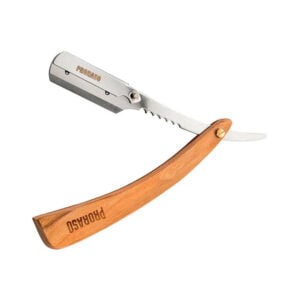
The razor consists mainly of two parts, a handle and a blade.
The magazine
The blade is usually made of carbon steel because it is easy to get very sharp and thin, something that is required for a blade for the razor.
Razor blades are made to have the best balance between elasticity and hardness, with a high resistance to wear and tear. They are usually made of plain steel, with a minimum carbon content of 0.6%. The material for making the knife blade itself consists of a cropped piece of steel that is between 5 and 6 millimeters thick and between 20 and 25 millimeters wide.
The steel piece is heated and hot-rolled before being forged under extreme pressure with a drop hammer. The hardening is very important for the knife blade and the temperature limits are in many cases crucial. The number of burrs depends on the quality of the steel. The leaf is heated to over 1000 degrees and then cooled down in a special oil. After that, the leaf is heated again, giving it its elasticity and toughness.
The advantage of carbon steel is, as mentioned, that it is possible to get a very thin blade with high sharpness. The downside is that it takes a lot of maintenance to keep the sharpness of the blade sharp. In addition, carbon steel is sensitive to water and can be damaged if exposed to a lot for a long time.
Stainless steel is also found among razors. Still requires a lot of maintenance but is not nearly as sensitive to water as carbon steel is. However, it can be difficult to achieve the same thinness and sharpness as in a carbon steel blade.
Leaves come in different widths and are given in inches, one inch equals 2.54 centimeters. The widths vary between 3/8 and 7/8 inches, most common in Europe are 5/8 and 6/8 inches. The width of the knife blade mostly affects the weight of the knife and how it should be handled.
When using the knife, it is important to be able to see the blade of the knife clearly in the mirror during the time. However, narrower blades are easier to use, so which size suits you best is a trade-off between what you find easiest to handle and how big your hands are.
Blade width
The most common width is 5/8 inches. It is also the one that we recommend for a beginner. But there are also several.
Blade width 6/8 inch
A good choice for slightly coarser beard growth. A knife blade with 6/8 is suitable for slightly coarser beard growth with thicker beard hairs. The slightly heavier wider blade gives a little better pressure in shaving off the coarser beard hairs. At the same time, it can be somewhat more difficult to get details and access in certain places.
Blade width 5/8 inch
A blade width of 5/8 inch is suitable for both beginners and experienced razors. 5/8 means that the knife blade is five-eighths of an inch.
A 5/8″ wide blade is great whether you are new to a razor or have been doing it for a while. This is because the width of the blade is suitable for most purposes when it comes to classic wet shaving with a razor. A blade with this width can handle both more general wet shaving and finishing and getting borders and other things in a nice way.
Blade width 3/8 inch
A great choice for precision and detail
Knife blades with a 3/8″ width are best suited for making small adjustments, straight borders and the like. In addition, straight in places where wider blades have difficulty accessing. At the same time, the lighter weight of the blade can make it slightly more difficult to handle.
The tip of the blade
A razor’s blade has slightly different types of tip where each type has its special advantages. You should always choose the type of lace you feel is suitable for you.
Barber’s notch
A knife blade with a tip called a barber’s notch has a soft curve at the bottom of the blade followed by a concave indentation in the blade and a less rounded top. Thanks to each concave indentation, it becomes easier to produce the blade.
Spanish Spitz (Also called concave Spitz)
A Spanish tip is characterized by having a strong concave inward bend in the leaf with an upper and a lower tip. This type of tip can be slightly more difficult than the others to maintain as the tips can easily break. But the advantage is that it is easy to access where other razors cannot. In addition, it can neatly create lines and contours.
French Spitz
A French tip has the shape of an asymmetrical quarter of a circle with a sharp curve at the top of the tip at the top. The advantage of a French tip is that it is easier to access in places where other razors may have difficulty. An excellent choice if you want to get slightly nicer borders and contours than you can get with a round tip but don’t feel that a straight tip is right.
Rounded lace (also known as Dutch lace)
A knife with a rounded tip has, just as it sounds, a soft rounded tip on the blade. This is the tip type that is recommended for a beginner as it is very forgiving in comparison to others. Compared to a straight tip, the precision is not as good and it can therefore be more difficult to get the same precise edges and contours. The advantage is that this type of tip is much more forgiving if you are unaccustomed to it.
Square lace
A knife blade with a square tip, or sharp tip. A square tip blade has an angle of 90 degrees from the top of the blade to the short side. This type of tip is especially good for precision shaving, but can also easily damage the skin. Precision shaving means that it can neatly create contours and edges in the beard in a neat way with high precision. The downside is that it can be unforgiving and difficult to handle if you are not used to it and have a steady hand.
Blade sharpening
There are three different types of knife blades when it comes to sharpening. The more sharpened the knife blade is, the more flexibility it has at the tip. It also affects the precision of the blade and how close you can shave.
The flexibility of the blade plays a major role in the shaving experience. As you get older, the skin loses its elasticity and firmness. The less firm the skin, the more flexibility is required by the blade of the knife.
The three main types of milling are full wedge, full hollow and half hollow.
A razor with a flat, unsharpened blade is called a “flat ground or full wedge”. This type of blade is usually not used for shaving anymore, although of course it is possible. The disadvantage in comparison to other types of blades is that this can be slightly more difficult to achieve the same precision and proximity in shaving.
Half-sharpened knife blades are called “Half hollow ground”. This blade means that you can not shave as close as with a fully sharpened blade, but at the same time you get a little better opportunity to control the blade.
Of course, the most important thing when it comes to sharpening the blade is what you prefer and feel what suits you.
Full hollow ground grinding of blades
Full hollow ground has high flexibility and can be used for shaving all types of skin. However, they are more expensive than the semi-hollow standard blade. Since they are thin and therefore very light, they can be slightly more difficult to get the precision if you are not used to it. At the same time, it is the type of blade that gives the absolute closest shave because you can go very close to the skin.
Handle
There are several different materials used for the manufacture of handles. The material that the handle is made of does not affect the usefulness of the knife. However, it does affect the experience and the feeling that the knife provides. It is important that it is ergonomic and comfortable to hold, for you to have a really comfortable and safe experience.
The type of handle you should choose depends entirely on personal preference and taste. Different types of materials can differ a bit in price, which must also be taken into account.
Handles made of synthetic materials such as hard plastic and similar materials or metal are generally slightly cheaper. The actual function of the razor has no bearing on the material of the handle. It’s just an aesthetic issue. Other more expensive materials such as wood, horn and the like are slightly more expensive but can give a more exclusive feel to the shave. In the past, a razor with a beautifully decorated handle or a handle in a noble material could be seen as a status symbol.
Wooden handle
Wood is an exclusive, highly durable material that makes a very beautiful handle. We offer a variety of different types of wood.
Wood is a very classic and commonly used material in the handles of razors. In addition, there is a large variety of different types of wood, which makes it easy to find a personal style and favorite. Why not Spanish oak, bamboo, olive wood or imitation ebony. This will be a very nice thing, maybe an heirloom and family heirloom that will be passed down from generation to generation.
Plastic handle
Plastic handles are a slightly cheaper, simpler material. But which can be had in many different nice colors and patterns.
The big advantage of plastic is that it is possible to get almost any color, any pattern and imitate almost any material. But at a lower cost than if you would have used the actual material. In some cases, also significantly better for the climate. Still handles of very high quality.
Shavette
A shavette is an excellent alternative to a razor for those who do not have the energy, time or other opportunity for above all the maintenance required for a razor. At the same time, the shavette provides more or less the same close shave as you get with the shavette.
Shavetten parts
As mentioned earlier, a shavette has a construction similar to that of a razor, but instead of a fixed knife blade that requires a large amount of maintenance, the shavette’s blade can be replaced. Either special shavette blades are used, or in some cases double razor blades that have been broken in half can be used. In some cases, the razor blade is mounted directly into the shavette, in other cases a blade holder is used.
Handle
The handle of the vast majority of shavettes is not very different from the handle of a razor. The purpose is to be able to fold in and protect the edge of the blade when the shavette is not in use.
Exceptions, however, are a Japanese kamasori. A Kamasori, which simply means razor or razor where the handle and razor blade are in one long part.
When it comes to shavettes in general, they often have handles made of simpler materials such as synthetic materials and metal. But there are also more exclusive such as precious woods.
The blade holder
The blade holder or shaver head of a shavette is usually made of stainless steel to make it easy to clean and maintain. Blade holders usually consist of one or two parts.
A shavette that has a blade holder or shaving head that consists of only one part, the blade is carefully inserted into a notch. Be careful and avoid injury. Also, make sure that the razor blade is properly seated.
In the case of shavettes from Dovo, for example, these come with a blade holder where the razor blade is first placed into the blade holder. Next, the blade holder is inserted into the slot.
Shavets that have, for example, two or three parts usually have a locking mechanism that must be opened up first. Then the parts can be taken apart. Then the razor blade is attached between the two parts, which are reassembled and locked in place with the locking mechanism. Be careful and careful to avoid cuts but make sure the razor blade is firmly attached.
Shavettebladet
A shavette can be used with special single-ground shavette blades that have one side. But which are sharpened on both sides of the blade. This is in contrast to a double razor blade that is sharpened on both sides on two edges.
Shavets from some manufacturers can also be used with most double razor blades. Then the double razor blade breaks off along the long side to get two blades with a sharp side. This should be done very carefully to avoid injury.
In the beginning when you shave with a shavette instead of, for example, a safety razor, it can be a good idea to choose a razor blade with a slightly softer sharpness than usual because the shaving is slightly different. When you feel more used to it, you can then go back to a sharper razor blade.
As with shaving with a safety razor, it is always important to never shave with a dull razor blade, which can increase the risk of cuts and other injuries.
The shavette leaves are made of metal and can be recycled.



Questions and answers about razors and shavettes
In our guide, we have collected some of the most common questions we receive. If you have more or other questions, please feel free to contact us.
Maintaining a razor is almost as big and important a part as shaving with a razor. The maintenance is mainly three parts, cleaning, grooming and sanding.
Grooming the razor is something that should always be done before every shave with the razor. It has two purposes. To remove dust and other small particles from the knife blade. In addition, straighten the microscopic waves that appear in the blade during shaving.
When you groom your razor, use a sharpener. The most traditional is a hanging shovel that is held in place at one end and attached to the other with a hook. There are also completely hand-held harrows.
A groom typically has two sides, one side that is covered with a heavy cloth and one that is covered with leather.
The fabric side is first used to clean dust and other small particles from the knife blade.
Then the leather side is used to straighten out the microscopic waves that are created in the razor blade. The waves occur naturally when the knife blade cuts off the beard hairs. If the waves are not straightened, there is a risk that the sharpness of the blade will deteriorate. Something that can lead to unnecessary wear and tear and or the risk of injury.
The cleaning of a razor is a very important part and not something that should be neglected or rushed past due to lack of time. If you find that you do not have time to thoroughly clean your razor, one piece of advice is to switch to a shavette where the need for cleaning is slightly less.
The most important reason to be thorough with the cleaning of your razor is to prevent the spread of bacteria. When you shave with a razor, it’s easy for bacteria and viruses to end up on the edge. If an accident then occurs and you cut yourself, there is a risk that these will get under the skin into the bloodstream. Something that can have serious consequences.
You should therefore always rinse the razor thoroughly after use. Keep in mind that parts of the razor can be extra sensitive to moisture. Therefore, be very careful. At the same time, it is important not to expose the razor blade to more water than necessary and to always gently wipe the razor blade. Very important that you use a special special clean towel for this and not your regular towel. Again, to reduce the risk of cross-contamination. Make sure the razor is completely dry when you set it aside and store the razor in a dry place.
You should preferably avoid strong detergents and the like. Plain lukewarm water is usually enough. If necessary, you can use a few drops of alcohol to clean the blade. But be sure to use a product designed for cleaning.
Keep in mind that the razor blade is usually not resistant to moisture and moisture. Something that can damage the blade.
Sharpening a razor is an important but also a very difficult process.
It requires great care and knowledge to be done right. If you are a beginner with a razor, it is recommended to let someone more experienced sharpen the razor for you. Of course, over time, you can learn it yourself. Feel free to start with another razor that you bought cheaply and do not intend to use for shaving. This is so as not to ruin your nice razor.
A soft brush, such as a toothbrush, can be used to remove all the hair and any soap residue on a shavette
Remember not to use the same toothbrush that you use to brush your teeth to clean your razor. It can cause the spread of bacteria and viruses.
A good rule of thumb is that every time you change the razor blades, also unscrew all the parts of the razor and clean them.
Strong detergents and the like can have a corrosive effect on the metal and should therefore be avoided. Use only a mild detergent if necessary. In the vast majority of cases, water is just fine.
No, not really all, but most shavette leaves can be used for all shavettes. Above all, shavettes and shavette leaves from Feather are the exception, which can only be used with each other.
In addition, almost all double razor blades can also be used with all shavettes.
Perhaps the most common question of them all.
Normally, you need to replace the shavette blade in a shavette after about 3-7 shaves. It is important to point out that some people need or want to change significantly more often, while others manage longer.
This can vary depending on factors such as beard growth, hardness of hairs, and how much you shave at a time. You can also feel the blade to determine if it is still sharp or if it has become dull and should be replaced.
It is important to change the blade regularly to avoid irritation and get a close and comfortable shave. In addition, the risk of cuts increases if you use a dull blade. By having multiple blades on hand and replacing them regularly, you can maintain a consistently high quality of shaving.
We recommend storing your shavette leaning in a rack. This is so that the water can easily drain off. If the water collects in a fragile part of the shavette and remains there, it can lead to unnecessary damage to the safety razor. In the long run, it can lead to the shavette breaking and no longer being usable.
We have a number of blog posts for those who want to know more about razors and shavettes.
A guide to help you choose the right razor in five steps
Read more: Choosing a razor in 5 steps
In our shaving guide, we’ll walk you through how to shave with a razor or shavette.